
Media Resource
March 24, 2025
How Brands Can Use RMN and CDP to Expand Their Marketing Reach and Raise Conversion Rates: Stop Betting on a Single E-commerce Platform!
Many small and medium-sized brands sell directly on e-commerce platforms such as Shopee and momo. This approach saves time and effort, but brands that bet everything on these platforms are likely to run into two major problems.
"If a six-inch cake is shared among 10,000 people, how much do you think you'll get?" Discussing the challenges of e-commerce, AviviD CEO Wing Lin used a vivid analogy—tens of thousands of sellers on a platform compete for a limited share of attention, and each slice of the cake they get is a single consumer click or view. In today's market, every bite is precious.
To cut costs and improve efficiency, advertising has long since shifted from mass-exposure traditional media ads to digital ads tailored to consumers. To achieve precision marketing, what brands need most is the support of "first-party data," meaning the data a company collects directly from its members and customers, such as website visit behavior and purchase history. By analyzing this data, a brand may be able to read what consumers are thinking, predict which product categories they are likely to add to their next purchase and which discount offers will interest them more, and run precision marketing aimed at each individual consumer.
Going All In on Platform Tools: How Can Brands Overcome Two Major Limitations?
However, most small and medium-sized brands that want to get their online business up and running quickly choose to sell directly on e-commerce platforms such as Shopee and momo. Once their products are listed, they can reach consumers directly through the platform's promotional tools and ad placements, then use the data collected in the seller dashboard to make follow-up marketing decisions, hoping for a one-stop solution.
Wing Lin points out that while this approach saves time and effort, brands that bet everything on e-commerce platforms are likely to run into two major problems.
The first is "limited resources." Brands and individual sellers keep pouring in, while the promotional tools and ad placements on any single platform are limited, and intense competition keeps driving costs up. "To do better, you may be willing to spend heavily on that one bet, believing you can beat everyone else, but in reality you're sitting down at the gambling table blindfolded," Lin says bluntly.
The second is "limited insight." The data and analytics tools in e-commerce platform dashboards are fairly basic, usually limited to metrics such as conversion rate, page views, and add-to-cart actions, with little data about the consumers themselves, such as which products they have browsed or what they are interested in. This makes it hard to dig deeper into or predict consumer behavior. For small and medium-sized brands, getting more detailed insight may mean higher costs and a higher technical barrier.
Lin notes that AviviD's clients are mainly small and medium-sized brands, many of which lack member data and depend heavily on a single platform. For this reason, AviviD offers solutions that span two major categories: advertising and MarTech.
Competing on Precision Targeting: Tagging Data for Cross-Site Exposure
For ad delivery, AviviD takes a "team play" approach. It works with more than 300 e-commerce sites and 500 media outlets and has 66 million subscribed devices, with data covering convenience stores, department stores, e-commerce platforms, media, the beauty industry, bookstores, pharmaceuticals, real estate, home appliances, and other businesses.
These partners provide de-identified, multichannel consumer data, including browsing behavior, purchase history, and interests, and an AI system then tags each consumer. For example, if Consumer A often buys women's clothing online and tends to stock up, this information is used to build a profile of Consumer A.
This data is exchanged among partners in the ad network. Once the ad content suited to a consumer has been determined, the ad is delivered to a suitable placement. For example, the customers of a women's clothing brand and a face mask brand may overlap, so the two brands can run ads on each other's websites, improving targeting accuracy and conversions.
For insight, AviviD offers a range of tools, including data analytics, customer relationship management (CRM), and customer data platform (CDP) solutions. Brands can manage members across channels on a single platform, and data from their official website, physical stores, LINE, or apps can all be used together. For example, AI can help determine when a consumer is likely to make a purchase and automatically offer a free-shipping coupon to encourage the order.
Lin shares the case of a traditional household goods retailer. When it first moved into e-commerce, it spent heavily on Meta and Google ads while also paying for expensive SEO services, yet a year later its traffic had not improved and its e-commerce revenue was close to zero. With help from AviviD's MarTech solutions, it grew daily impressions from zero to 30,000 within a year, with a conversion rate as high as 210%.
"When you use these solutions to own your member data, your business isn't here today and gone tomorrow. It becomes a business you can keep running," Lin says.
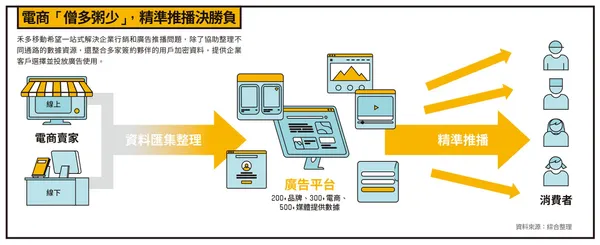
Image: Business Next
RMN + CDP: Helping Brands Reduce Their Dependence on E-commerce Platforms and Achieve Precision Marketing and Long-Term Growth
In today's highly competitive e-commerce environment, brands that rely only on a single e-commerce platform (such as Shopee or momo) face rising ad costs, limited data, and intense competitive pressure. To overcome these limitations, the retail media network (RMN) and the customer data platform (CDP) have become key solutions that help brands gain more control over their data and target their ads more precisely.
Through an RMN, brands can partner with different channels to extend their ad reach and precisely target consumer interests. At the same time, a CDP lets brands integrate their first-party data, analyze customer behavior in depth, and deliver personalized marketing, raising conversion rates and customer lifetime value (CLV).
Going forward, as AI technology and marketing automation continue to develop, brands with a complete data strategy will be able to respond more flexibly to market changes and take a leading position in the digital advertising ecosystem. Breaking free from dependence on a single platform and using RMN + CDP to build a traffic pool the brand owns is the key to long-term success!
AviviD
CEO: Wing Lin
Founded: 2013
Employees: about 80 on the Taiwan team
Services: retail media advertising (LRMN), CDP (LCDP), recommendation engine
Track record: more than 300 e-commerce clients, more than 500 media partners, and more than 200 brand partners
Clients: Jingche (Pegavision Group), Ai Shang Xin Xian, Lian Jia Xiao Pu, and others
Editor: Tsung-Ying Hsieh