
Media Resource
March 24, 2025
Beyond Traditional Advertising: How Retail Media Networks (RMN) and Customer Data Platforms (CDP) Improve Ad Precision
Using RMN and CDP to integrate data and build efficient, personalized ad delivery strategies
According to Reuters, GroupM, the world's largest media investment group, recently projected that advertising revenue from retail media networks (RMN) could surpass TV advertising revenue by 2028, accounting for 15.4% of total advertising revenue. Its parent company, WPP, also noted that retail media will be the third-fastest-growing advertising service, behind only out-of-home screens and connected TV.
This also reflects that consumer goods brands will invest large advertising budgets in retail media, beyond existing channels such as Google and Facebook. In addition, as GDPR has limited the ability to collect third-party data, the importance of RMN is becoming clear.
RMN not only brings new revenue streams to advertisers and retailers; it also brings other changes: "turning e-commerce into a multimedia advertising channel" and "turning retail into a model that increases website transaction value," effectively converting member data into first-party data.
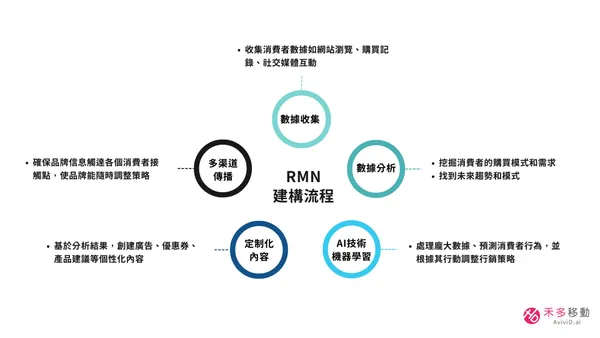
Image: AviviD
What Exactly Is RMN?
What exactly is RMN? RMN is a new advertising model built on the retail industry. The quickest way to put it into practice is to "buy ad space from retail brands." Ad space includes online and offline, on-site and off-site placements. Retail brands can not only deliver their own ads precisely across their own omnichannel network but also sell these placements to others as advertising products. However, this requires management platforms and technology to integrate data scattered across consumer touchpoints. The biggest benefit is that precise ad delivery remains possible even as third-party data is phased out.
Imagine a large brand that wants to advertise both online and offline. When third-party cookies are phased out after 2024, data management platforms (DMP), which provide targeting data for ad delivery by receiving cookies, will be affected. As a result, ad targeting accuracy may decline and ad costs may rise.
With third-party cookies about to be phased out, everyone in digital advertising is looking for alternatives. Besides DMPs, another data management platform that can integrate a website's first-party data, the customer data platform (CDP), has started to receive attention. As CDPs become more comprehensive, the shape of RMN will become clearer. And as RMN implementations mature, they will soften the impact of the loss of cookies and may even provide a more precise basis for ad targeting than before.
What Infrastructure Is Needed to Build an RMN?
For players who want to take part in RMN, having a CDP is therefore very important. In addition, we have identified four main platforms that will make up RMN in the future:
1. DSP: Demand-Side Platform
A platform that lets advertisers buy digital advertising inventory and manage different ad exchanges and data exchanges.
2. DMP: Data Management Platform
Processes first-party data (from customers, CRM and/or marketing automation databases, or purchase transactions), second-party data (data provided by other companies, such as partners and distributors), and other data sources. It provides anonymous customer data to other platforms, including ad exchanges, DSPs, and supply-side platforms (SSP), helping companies better understand customer behavior.
3. CDP: Customer Data Platform
Can also process first-party, second-party, and third-party data, but unlike a DMP, it can identify specific data about individual customers, such as email addresses.
4. SSP: Supply-Side Platform
A platform through which media offer advertisers a choice of ad placements. Its main functions are ad placement selection and ad transactions, helping media monetize the traffic on their websites' ad placements.
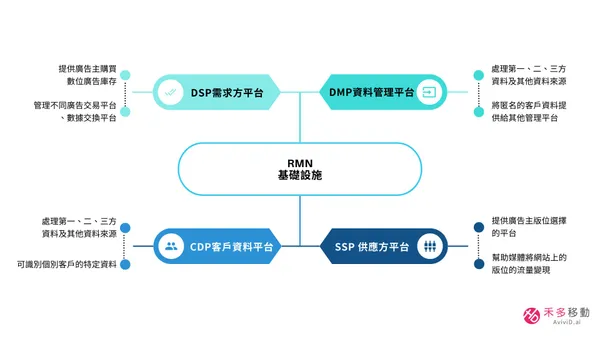
Image: AviviD
For retailers that want to develop retail media, there is currently hardly any one-stop solution on the market that solves everything. Retail media mainly combines on-site and off-site advertising resources and the data from both. On-site requires building an ad server, and off-site requires building a demand-side platform. Both need to include the following systems:
- Data licensing
- Analytics
- Order management
- Reporting
- Ad content management
- Audience management
- Media buying
Want to Get into RMN? Where Should Beginners Start?
Back in Taiwan, many retail and media groups are looking for the CDP that best suits them, so they can build up their own first-party data and integrate scattered member data. To build a complete data integration platform, they can turn to overseas providers, and a number of local Taiwanese companies are also developing such platforms. Large retail brands have started to consider how their omnichannel networks can create additional advertising opportunities, while small and medium-sized players are entering the world of RMN by buying off-site channels.
AviviD.ai has the largest first-party push notification advertising traffic pool and the potential to integrate on-site and off-site advertising. It develops both AdTech and MarTech services and can provide AI solutions for every online consumer touchpoint (off-site, on-site, and retargeting), driving automated marketing for businesses. Over the past decade, AviviD.ai has served more than 500 e-commerce and media companies and has even partnered with leading offline retailers. This breaks down the boundaries between traditional advertising, media, and retailers, enabling ad delivery across advertising, media, e-commerce, and retail. By providing more precise user attribute data through its CDP, it has created new business opportunities for the digital advertising industry, and it will integrate online and offline services in the future for even more precise ad delivery.
RMN and CDP Together Usher in a New Era of Digital Advertising
With the rise of retail media networks (RMN) and the widespread adoption of customer data platforms (CDP), brands are gaining more precise and efficient ad delivery models. Traditional digital advertising relies on third-party cookies, but as privacy policies tighten and data becomes fragmented, combining RMN and CDP gives companies a viable solution.
Through first-party data integration, AI-driven marketing, and omnichannel coverage, brands can not only gain deeper consumer insights but also improve ad conversion rates and customer loyalty. As the retail media advertising market keeps growing, companies that use CDP technology effectively to strengthen their RMN marketing strategies will be able to build a competitive advantage in digital advertising and achieve a higher ROI.
Media coverage: Beyond Traditional Advertising: RMN and CDP Join Forces to Make Advertising Better
Related

Media Resource
2023-08-31
First E-Commerce Trend Forum Concludes! HoDo Mobile Predicts the Trends: RMN and Precision Marketing are Here to Stay
Read Now
Media Resource
2025-03-18
Southeast Asian Media Giants Expand RMN Ecosystems, Backed by AviviD's Taiwanese Tech Innovation
Read Now
Media Resource
2025-03-21
AviviD Likr RMN: Data-Driven Advertising That Helps Even Beginners Reach the Right Audience
Read Now
Media Resource
2025-03-21
AviviD Hosts the 2024 RMN ASIA Summit: The Future of AI-Driven Retail and Information Security
Read Now
Media Resource
2025-03-24
Seeing Momentum in Singapore and Malaysia's Retail Sector, AviviD Partners with SiteGiant to Expand Its Retail Media Network (RMN) and Grow in Southeast Asia
Read Now
Media Resource
2025-03-24
As Retail Marketing Goes Omnichannel, How Can Retail Media Networks (RMN) Help Brands Break Through?
Read Now
Media Resource
2025-03-24
AviviD's Innovative LRMN Technology Tackles the Ad Cost and Data Security Challenges of Retail Media Networks (RMN)
Read Now
Media Resource
2025-03-24
INSIDE FUTURE DAY RMN INSIGHT: How AviviD Uses RMN and CDP to Build Personalized-at-Scale Marketing Strategies
Read Now